Uttar Pradesh Chief Minister Yogi Adityanath, known for his hardline Hindutva views and 'bulldozer justice' approach, has spoken out about his policies toward Muslims, the Waqf board, and his vision for India. He asserts that Muslims will receive a fair share of development in Uttar Pradesh, but not special concessions. He also criticizes the Waqf board for its alleged appropriation of government properties and calls for its reform. Adityanath defends his 'bulldozer justice' policy, claiming it is necessary for infrastructure development and removal of encroachments. He also discusses his vision for India, emphasizing the importance of Hindi as a national language and the need for unity across different linguistic groups.
With its age-old fascination for education, southern states have done better than the North. Start-ups, IT hubs, and industry majors setting up shop have changed the face of the South. Nearly 79% of global offices set up by international conglomerates in India are in the South. Almost 46% of tech unicorns are from the South. The GDP per person in the South is 4.2 times higher than the North. None of these indicators can be ignored by any central government, whatever the political compulsions, notes Ramesh Menon.

'...how do they consume and contribute to the GDP?'

'The bull market cycle ran for five years. It's the end of that cycle.' 'The next cycle is a down cycle, and in that down cycle, you will see the Sensex falling from their highs of around 68,000 to maybe 40,000-50,000 at the bottom of the cycle.'
The launch of the first-ever direct train service from Delhi to Kashmir would be a big turning point in the Valley's mood and its integration with India. He had to thwart it at any cost, asserts Shekhar Gupta.

India maintains "high" import duties on a wide range of American goods such as agricultural items, drug formulations, and alcoholic beverages, besides imposing non-tariif barriers, a US report has said. A day before announcing reciprocal tariffs, the US Trade Representative (USTR) released the 2025 National Trade Estimate (NTE) Report on March 31.

Two long-stalled reforms are lifting FDI cap in insurance and simplifying land acquisition for factories.
The two sides are also likely to firm up a currency swap framework and seal several other agreements including one on debt restructuring following talks between Modi and Sri Lankan President Anura Kumara Disanayaka on April 5, people familiar with the matter said.
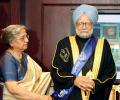
Nitin Desai, who has known Dr Singh from 1971, extends his 'deepest condolences to his wife Gurcharan Kaur and to his three talented daughters Upinder, the historian; Daman, the writer; and Amrit, the human rights activist.'

'It brings precarious peace because the red lines have shifted. 'The next Pahalgam attack would mean a full scale war.'

'The 2024 election results will lead to much intense targeting of Modi, more intense debates, many more breakdowns in Parliament and many more movements on the streets.' 'The results have hit Modi's standing, and the politics of the Opposition parties will be sharply focused to ensure that Modi doesn't get back his charisma of being 'invincible' with help of State power.' Sheela Bhatt looks at the political situation through the prism of 2024 Lok Sabha election results.
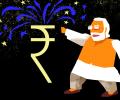
President Trump with his MAWA has unwittingly provided us this opportunity. Will PM Modi grasp this and leave a legacy of an ushered in scientific and technological revolution in India, asks Colonel Anil A Athale (retd).
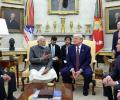
'No retaliatory tariffs now. You can retaliate after a few months.' 'Today, there is no need to retaliate because it is a question of long term benefits.'
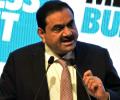
Challenging the decision of the Biden Administration to investigate the activities of Indian billionaire Gautam Adani and his companies, an influential Republican lawmaker on Tuesday said such selective actions risk damaging critical alliance partners.

'In the long run, I don't foresee major ramifications [about Trudeau's allegations].' 'There's just enough hypocrisy among Western nations for India to douse the outrage.'

'The time has come to have a relook at the Constitution as every document has a shelf life.'
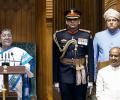
President Droupadi Murmu addressed both Houses of Parliament, highlighting the government's achievements in various sectors, including economic growth, social welfare, and infrastructure development. She emphasized the government's efforts to lift the economy out of "policy paralysis" and create a more inclusive society. Murmu also acknowledged the challenges posed by digital fraud and cybercrime and stressed the need for a social infrastructure revolution. The President's speech is considered a policy statement, outlining the government's vision and roadmap for the future.
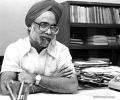
What stood out in his 15-year journey as a member of the political executive at the Centre was his glowing record as India's most successful and effective finance minister. Both as prime minister and finance minister, he understood the importance of gradualism, except when the economy or the polity was in a crisis.
If the concerns over risking political capital are overcome, the long-term gains for the Indian economy will be immense, asserts A K Bhattacharya.

A freebie once granted can hardly be discontinued. All that can happen is to substitute it with a bigger freebie, notes A K Bhattacharya.

'The upper caste elite's belief that they are casteless is a belief that is available only to the upper castes. Because all the lower castes are reminded by society every day what their caste is.'

'Today, both in the hills and valley there is radicalised militant activity which poses a direct national security threat.' 'This kind of militancy in Manipur is unprecedented, I have never seen such largescale militancy in my life.'

The US Trade Representative noted that India's average applied tariff rate stood at 17% per cent, the highest of any major world economy.
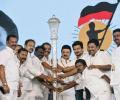
'Peninsular Indians could ask 'Why should we contribute half of India's tax revenues if we account for only a quarter of the seats in the Lok Sabha?'.' 'The rest of the country seems likely to counter that 'democracy means one vote per person irrespective of where that person resides in India'.' 'With no easy answers to this thorny debate, the south's economic ascendancy could end up creating a Hobson's choice.' A revealing excerpt from Nandita Rajhansa and Saurabh Mukherjea's book, Behold the Leviathan: The Unusual Rise of Modern India.

The share of adults who say the economy is 'very good' (30 per cent) has tripled in the past three years, it added.

Private investment will respond only to sustainable reform.
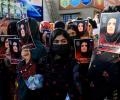
'When so many young Baloch men and women are willingly volunteering as fighters and even suicide bombers.'

The Bharatiya Janata Party (BJP) has alleged that former Congress president Sonia Gandhi has links to an organisation financed by the George Soros Foundation, which has reportedly supported the idea of an independent Kashmir. The party claims this connection demonstrates foreign influence in Indian internal affairs. This comes after BJP's claims of US involvement in destabilizing India, which the US has denied. The BJP also accused Congress leader Rahul Gandhi of collaborating with the Soros-funded OCCRP to damage India's economy and reputation. The allegations have drawn criticism from the US embassy and the opposition Congress.
Delhi faces a severe financial crunch and the deficit is largely due to numerous welfare schemes without adequate revenue flowing in. The success of welfare schemes and electoral promises will need careful financial planning and out of the box thinking to whip up additional revenue, notes Ramesh Menon.

'The first and most basic responsibility of any government is to protect its people from external threats and internal harm.' 'Budget 2025-2026 has to focus on meeting this responsibility,' asserts R Jagannathan.

In this round, the market has won. But it is still for Gautam Adani to decide whether he has lost or not, argues Shekhar Gupta.
The director of the Indian Institute of Technology (IIT) Madras, V Kamakoti, has sparked controversy after making a remark about the "medicinal value" of cow urine, or "gomutra." Kamakoti, while speaking at an event celebrating Maatu Pongal (a festival dedicated to cows and bulls), cited an anecdote about a sanyasi who was cured of a fever by consuming gomutra. He also claimed that gomutra has "anti-bacterial, anti-fungal, and digestive properties." The remark has been widely condemned by rationalist organizations, political leaders, and medical professionals who have criticized Kamakoti's statements as "pseudoscience" and "regressive." The controversy highlights the ongoing debate in India around traditional beliefs and scientific evidence.

The TMC-led West Bengal government has already started laying the groundwork for the election, setting the tone with the recent Bengal Global Business Summit and the state Budget.

In a warning sign for the Democrats, Indian-Americans' attachment to the party is declining in the United States while the share of Republican identifiers held steady.

We must bring a laser focus on our own interests, and define our friends and foes more clearly instead of trying to live by somebody else's rules. We must grow up, think for ourselves, think India First, asserts R Jagannathan.

"Indian slums are incredibly productive," said Saumitra Jha, assistant professor of Political Economy at the Stanford Graduate School of Business.
'By his words, actions, and body language during their joint press appearance wanted to convey his personal respect and, more broadly, his desire to work closely with India.'

At a time when the BJP's stars are at the top on the eve of the Lok Sabha polls, the Puri-Joshimath Sankaracharyas may have kick-started a row whose efforts might be to divide Hindus, not in the name of castes, but on what passes for greater belief, observes N Sathiya Moorthy.
